










Which One to Buy?
Two machines. Two different jobs. This guide tells you which one fits what you're doing, and stops you from burning through your clearcoat.

For most people, buy a DA polisher. It's safer, easier to use, and finishes cleaner. A rotary cuts faster and handles heavy correction, but it can burn paint in seconds if you stop moving. Beginners always start with a DA.
If you've been searching DA vs rotary polisher (or dual action vs rotary polisher, or DA vs rotary buffer, all the same thing), you're probably trying to figure out which one to buy first. The honest answer for 95% of people is a DA. For the rest, it's both. This guide walks you through which to pick, what to pair it with, and which machines we actually stock at Detailing Shed.
What's the difference?
DA vs rotary in plain termsDA Polisher (dual action)
A DA spins the pad two ways at once. It rotates around the centre and also orbits in a wider random pattern. When you press down, the pad stalls. That's the safety net. Heat doesn't build up in one spot, and the random motion stops swirl patterns from forming.
Best polisher for beginners. Safe on every paint type. Slower at heavy correction.
Rotary Polisher
A rotary spins in one direction at high speed. Direct power, no orbital motion, no stall. It cuts faster than anything else. The trade off is heat. Hold it in one spot for a few seconds too long and you'll burn through clearcoat.
Built for cutting heavy defects. Needs experience. Leaves holograms that a DA has to clean up.
Which one should you buy?
The decision in plain languageBuy a DA if you've never polished a car before. Buy a DA if you're working on a daily driver. Buy a DA if you're prepping paint for ceramic coating. Buy a DA if you only correct one or two cars a year. That covers most people.
Buy a rotary if you've used one before, or you're prepared to practice on a junk panel first. Rotaries make sense for heavy correction work like deep scratches, oxidation, old single stage paint, and caravan or boat gelcoat that's been baking in the Australian sun for years.
Buy both if you're correcting more than 5 cars a year. Most pros own both. Rotary for the cut, DA for the finish. The two machine workflow is faster than a DA alone on heavy defects, and cleaner than rotary alone because the DA wipes out the holograms.
The honest answer: the best polisher for beginners is always a DA. We've seen too many panels ruined by people who jumped straight to rotary because it cuts faster. Start safe. Move up later if you need to.
Side by side comparison
DA vs rotary buffer: the basics| Factor | DA Polisher | Rotary Polisher |
|---|---|---|
| Beginner Safety | High. Pad stalls under pressure. | Low. No safety stop. |
| Cutting Power | Moderate. Depends on orbit size. | Highest. Cuts deepest, fastest. |
| Burn Through Risk | Very low. | High in beginner hands. |
| Hologram Risk | Very low. | High. Needs DA finish pass. |
| Heat on Paint | Low. | High. Can burn if stationary. |
| Edge Safety | Forgiving. | Aggressive. Strips edges fast. |
| Speed of Work | Slower. | Fast on heavy defects. |
| Finish Quality | Hologram free. | Holograms. Needs DA pass. |
| Skill Required | Hours. | Months of practice. |
| Starting Price (AUD) | From $199. | From $329. |
Pads and compounds: what to pair with each
More important than the machine itselfThe machine is half the story. The pad and compound you pair it with is the other half. A DA with the right pads outperforms a rotary running the wrong combo. Get this part right.
For a DA polisher
- Heavy correction. Microfibre cutting pad or wool pad with a heavy cutting compound. Pairs like Lake Country MF cutting pads with Sonax Ultimate Cut 6+ give you real cutting power on a DA.
- Medium correction. Foam cutting pad (orange or yellow High Pro) with a medium polish. Handles 80 to 90 percent of paint correction on Australian daily drivers.
- Finishing and coating prep. Soft foam finishing pad (black or red) with a finishing polish like Labocosmetica Fiero or Sonax Perfect Finish. Removes haze, refines gloss, leaves a coating ready surface.
Shop polishing pads and compounds at Detailing Shed.
For a rotary polisher
- Heavy cutting. Wool pad with a heavy cutting compound. This is what a rotary does best. Removes deep scratches, oxidation, and sanding marks fast.
- Medium cut. Foam cutting pad with medium compound. Rare workflow. Most operators jump straight from heavy wool to a DA finish pass.
- Finishing. Don't try to finish on rotary alone. The holograms are too risky to leave on the paint. Switch to DA for finishing.
Common pad mistakes
Cutting pad on soft paint creates marring. Older Mercedes, Audi, BMW, and Japanese paint are typically soft. Aggressive pads leave hazing you'll need to remove with a softer pad after. Start gentler than you think.
Finishing pad on hard paint achieves nothing. Hard German clears (newer BMW, Porsche) resist gentle pads. You'll polish for an hour and see zero correction. Step up to a cutting pad sooner.
How different paint types behave
Rotary vs DA for paint correction on real carsHard German clearcoats
Newer BMW, Porsche, modern Audi. The hardest clearcoats on the road. A DA polisher with a finishing pad often gets nowhere on these. Step up to a cutting pad. A DA might need 2 or 3 passes for what a rotary handles in one. For serious correction on hard German paint, the Dynabrade Forced Rotation is closer to rotary cutting power without the burn risk.
Soft European paint
Older Mercedes, Volvo, Citroën. Cuts fast but mars easily. A DA polisher with a foam cutting pad and medium polish is the safer choice. Rotary on soft paint will almost certainly leave holograms that a DA has to clean up.
Japanese OEM paint
Toyota, Mazda, Honda, Subaru. Variable. Usually softer than German, harder than older European. Most Japanese cars polish well on a DA with a foam cutting pad and medium compound. Toyota and Mazda factory paint can be thin in spots. Common to measure 80 to 95 microns total film build on a Hilux against 110 to 130 microns on most German cars. A paint thickness gauge is worth it before aggressive correction.
Repainted panels
Always unknown. A repainted panel could be 50 microns or 200 microns. There's no way to tell without measuring. Use a Defelsko PosiTector or NexPTG before any correction. A DA polisher with a finishing pad is the safe default on repaint of unknown thickness.
How to use a DA vs a rotary
Step by step usage differenceDA polisher workflow
- Wash, decontaminate (iron remover and clay), dry. Mask off trim and rubber.
- Prime the pad with 4 or 5 small dots of compound. Spread across a 30cm x 30cm section at machine off.
- Start at speed 3 to spread. Move to speed 4 or 5 for working.
- Firm pressure, not heavy. About 4 to 5kg of downward force. Pad shouldn't visibly slow.
- Move 1 to 2cm per second. Overlap passes 50%. Cross hatch pattern: two passes north south, two east west.
- Wipe residue with a microfibre. Inspect under direct light. Repeat the panel if defects remain.
Rotary polisher workflow
- Same prep: wash, decontaminate, dry, mask. Plus check paint thickness with a gauge.
- Prime wool or foam pad with compound. Slightly less than a DA.
- Start at 600 to 800 RPM to spread. Move to 1200 to 1500 RPM to work. Don't go above 1800 RPM without a specific reason.
- Light pressure. Let the machine do the work. Pressure means friction means heat.
- Never stop the pad on the panel. Even for a second. Constant movement.
- Touch the panel after each section. Should be warm, never hot. Hot means stop.
- Wipe residue. Plan a DA finish pass to clean up any holograms.
The biggest rotary mistake: stopping the pad on the panel. Even for a second. The heat goes straight through the clearcoat. Keep moving or stop the machine.
Long term cost over 5 years
Total ownership, not just sticker priceFor a typical DIYer doing 4 to 6 polishing sessions a year, here's the actual 5 year cost.
| Cost | DA Only | Rotary Only | Both |
|---|---|---|---|
| Machine | $199 (M8S V2) | $329 (M1000) | $528 |
| Pads over 5 years | $280 | $320 | $420 |
| Compounds | $120 | $160 | $200 |
| Backing plates | $45 | $55 | $100 |
| Microfibres & lighting | $80 | $80 | $80 |
| 5 Year Total | $724 | $944 | $1,328 |
A DA on its own comes out around $725 over 5 years for most home users. Adding a rotary brings the total to roughly $1,330. Worth it if you're correcting heavy paint regularly. Overspend for a daily driver. The Polishing Starter Kit at $317.95 bundles the M8S V2 with pads and compound. Best starting point if you're buying from scratch.
The pro workflow: rotary plus DA
Why most professionals use bothWalk into any serious detailing shop and you'll see both machines on the bench. Almost no pro uses a rotary alone for a final result. Rotary does the heavy work. DA cleans up after.
The two stage workflow
- Stage 1: rotary cut. Wool or heavy foam pad with cutting compound. Around 1200 to 1500 RPM. Removes deep scratches, sanding marks, heavy oxidation. Expect holograms at this point. That's fine.
- Stage 2: DA refine. Foam polishing pad with a finishing polish. Cross hatch over the same panels. Cleans up the rotary holograms, refines gloss, leaves a coating ready surface.
- Stage 3 (optional): DA finish. Black finishing pad with the lightest polish. Final pass before ceramic coating prep.
The combo is faster than DA alone on heavy paint, and cleaner than rotary alone. For a 1 car a year DIY user it's overkill. For anyone correcting 5 or more cars a year, the dual machine setup pays for itself within months.
Common mistakes to avoid
What goes wrongJumping straight to rotary
The biggest mistake beginners make. First hour with a rotary on real paint should never happen. Practice on a scrap panel from the wrecker first. Burn marks on a customer's car aren't the time to learn.
Thinking the machine matters more than technique
A good operator with a $199 DA will out finish a beginner with a $1000 rotary every time. Pad and compound choice often matters more than DA vs rotary. Focus on technique first.
Skipping decontamination
Polishing dirty paint just grinds contamination into the clearcoat. Always wash, iron remove, and clay before polishing. See our paint prep guide.
Wrong pad for the paint
Cutting pad on soft paint creates hazing. Finishing pad on hard paint does nothing. Start gentler than you think. Step up if you need to.
No paint thickness gauge on older cars
Any car over 10 years old probably has a repainted panel somewhere. A gauge tells you which panels are safe to cut hard on and which need finishing only. Cheap insurance.
Forced rotation: the middle ground
More cut than a DA, safer than a rotaryGear driven forced rotation machines use a mechanical orbit that doesn't stall under pressure like a regular DA. The result is consistent cutting power across the whole panel, but with the orbital motion that prevents holograms. Cuts harder than a DA. Safer than a rotary. The Dynabrade Forced Rotation DA is the standout in this category in Australia.
Machine recommendations
What we stock and recommend
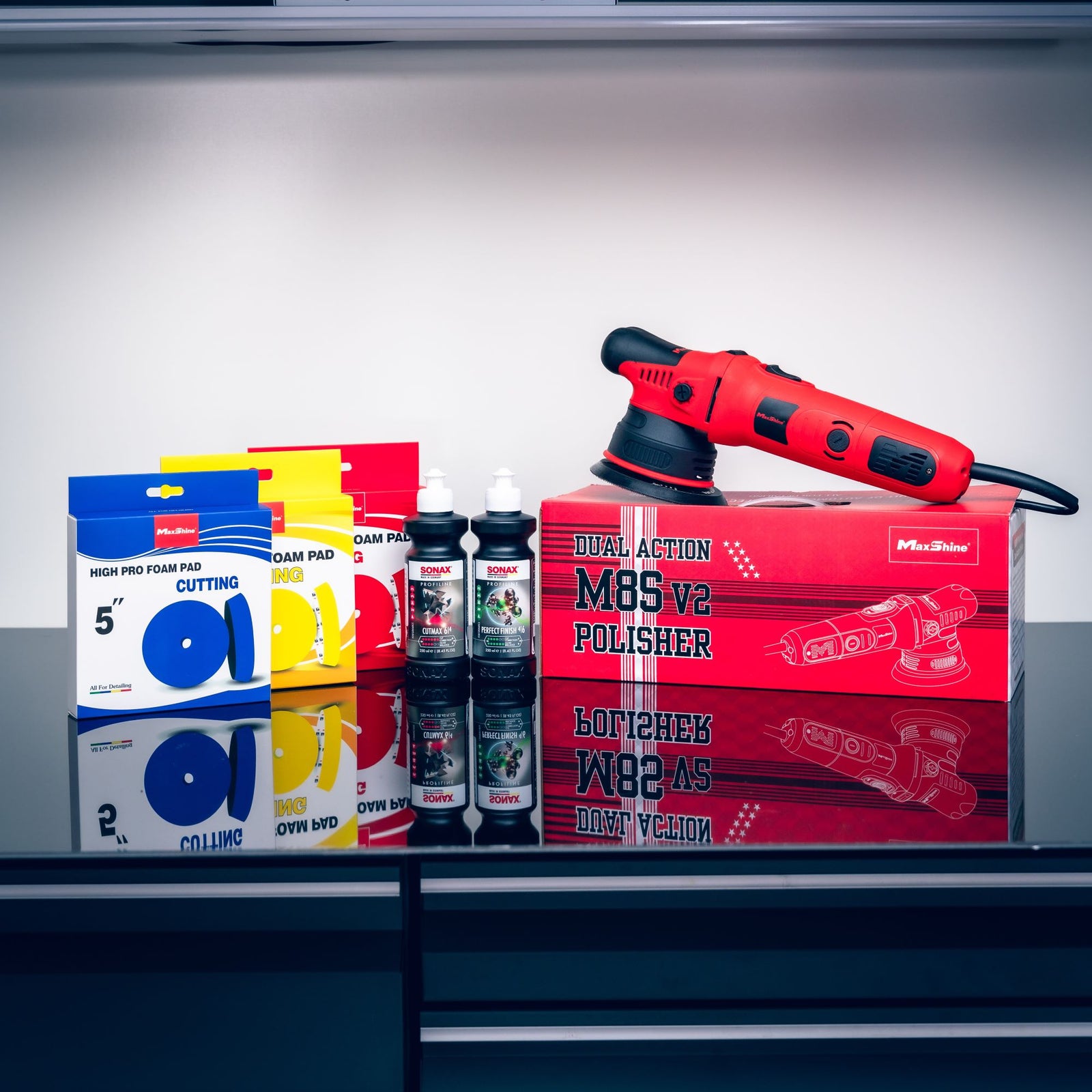
8mm orbit, 1000W, 3.8m cable. The most recommended starter DA in Australia. Safe, forgiving, easy to control.
$199 AUD. Kit with pads from $289.95.
15mm orbit, 1000W, progressive trigger with lock. More cut than the M8S. Right for heavier correction.
$329 AUD. Kit with pads from $398.50.
Gear driven orbit that never stalls. Cuts harder than any standard DA. No holograms. The serious DIYer's one machine answer.
$895 AUD.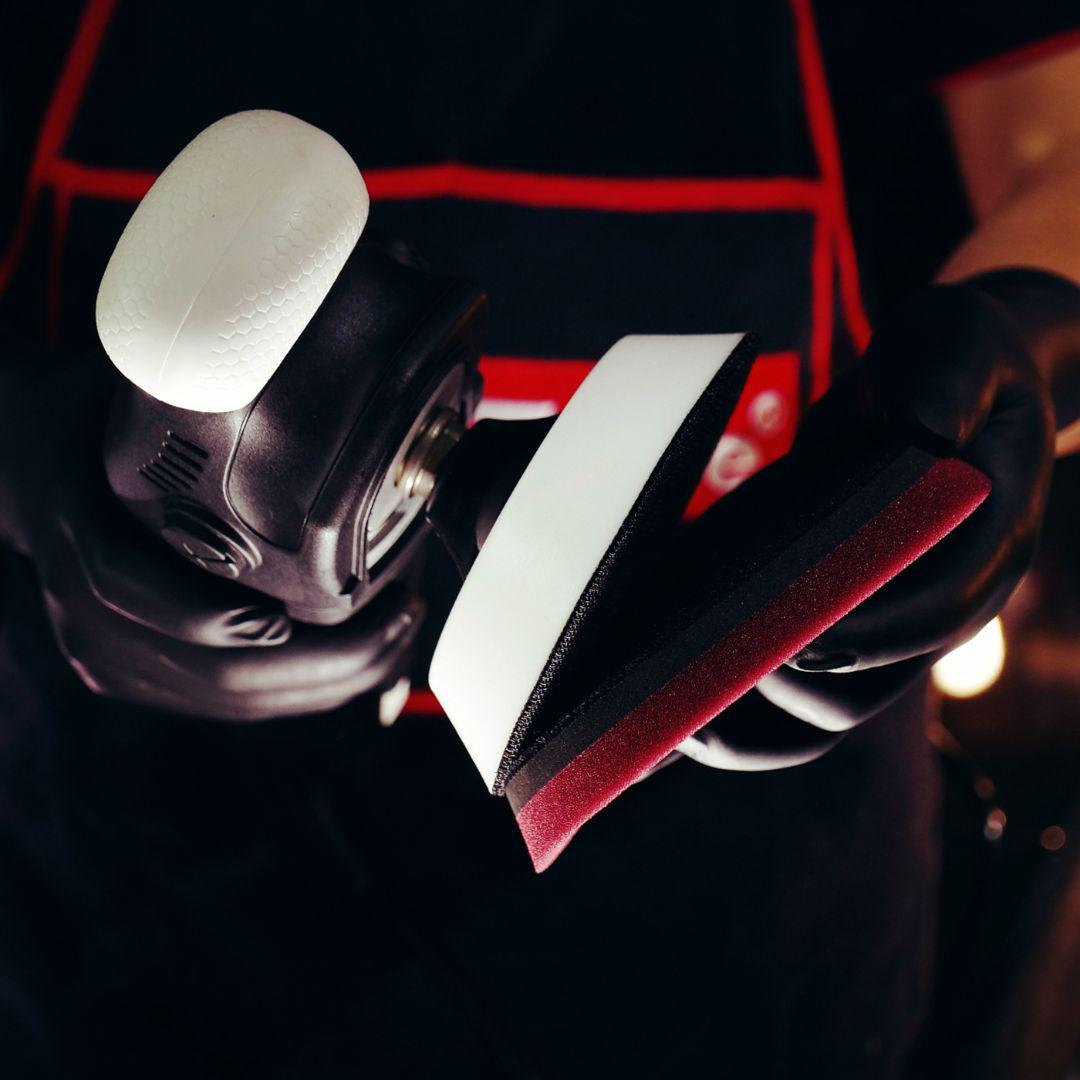
Pro grade rotary. Variable speed, solid build. Only buy this if you've used a rotary before or you're committed to practicing on scrap panels first.
Starter kits
Machine, pads, compound in one purchaseBuying the machine alone means another $100 to $200 in pads and compounds before you can use it. Our polishing kits bundle the right machine with pads and Sonax compounds.
- Polishing Starter Kit. From $317.95. M8S V2 plus Maxshine High Pro pads (cut, polish, finish) plus Sonax Ultimate Cut 6+ and Perfect Finish. Complete first time setup.
- M15 PRO v2 Pad Kit. From $398.50. M15 PRO with pads included. Better for heavier correction.
FAQ
Quick answersIs a DA polisher better than a rotary?
For most people, yes. A DA is safer, easier to use, and delivers excellent results on 90% of paint correction jobs. A rotary cuts faster but adds the risk of burning paint. For Australian DIYers, the DA is the smarter call almost every time.
Is DA or rotary better for beginners?
DA, every time. The dual action motion stalls the pad under pressure and prevents heat buildup. Both are built in safety mechanisms that protect your clearcoat. A rotary in beginner hands is the most common reason for burned paint in DIY detailing. Start with a Maxshine M8S V2 for $199.
Can a rotary polisher burn paint?
Yes. Easily. A rotary at 1500 RPM held in one spot for a few seconds can generate enough heat to burn through clearcoat into the basecoat. Damage is permanent and needs a respray to fix. Risk is highest on body lines, edges, and thin panels. Keep moving, use light pressure, check panel temperature regularly.
Can a DA remove scratches?
Yes for light and moderate scratches. A DA with a cutting pad and compound removes most swirls, fingernail scratches, and surface oxidation. Deep scratches that catch your fingernail need either multiple DA passes or rotary correction. Rule of thumb: if you can feel it with your fingernail, one DA pass won't fix it.
How long does paint correction take with DA vs rotary?
Full car DA single stage: 4 to 6 hours. Full car DA multi stage: 8 to 12 hours. Rotary plus DA two stage workflow: 6 to 9 hours total. The DA is faster for light correction. The rotary is faster for heavy correction. The combo is fastest for serious work.
Do professionals use DA or rotary?
Both. Almost no pro uses a rotary alone for a finished result. Standard workflow is rotary for cutting then DA for finishing. Some pros doing only coating prep or light correction use DA only. Hard German clears get rotary first. Soft European or Japanese paint often gets DA only.
Why do professionals still use rotary polishers?
Because rotary cuts faster on heavy defects. A wool pad on a rotary at 1500 RPM removes deep scratches in one pass that a DA needs three passes for. For a shop correcting 5 cars a week, that time saving adds up to hours. The DA still does the finishing pass.
Does a DA leave a better finish than a rotary?
Yes, almost always. The random motion of a DA prevents the buffer trails (holograms) that a rotary tends to leave. For final finishing before ceramic coating prep or for a show car, the DA is the standard finishing tool regardless of which machine did the cutting.
Do you need both a DA and a rotary?
Only if you're doing advanced or professional level paint correction. For DIY on one or two cars a year, a DA alone handles everything you'll see. If you're correcting heavily damaged paint regularly, restoring older cars, or running a side business, both machines make sense.
Can I polish caravan or boat gelcoat with a DA?
For light oxidation, yes. For heavily chalky gelcoat that's been baking in the Australian sun for years, a DA doesn't have the cut. Use a rotary with a wool pad to remove the oxidation, then a DA with a finishing pad to clean up the holograms. Don't skip the DA finish step. Gelcoat shows rotary swirls even worse than automotive paint.