




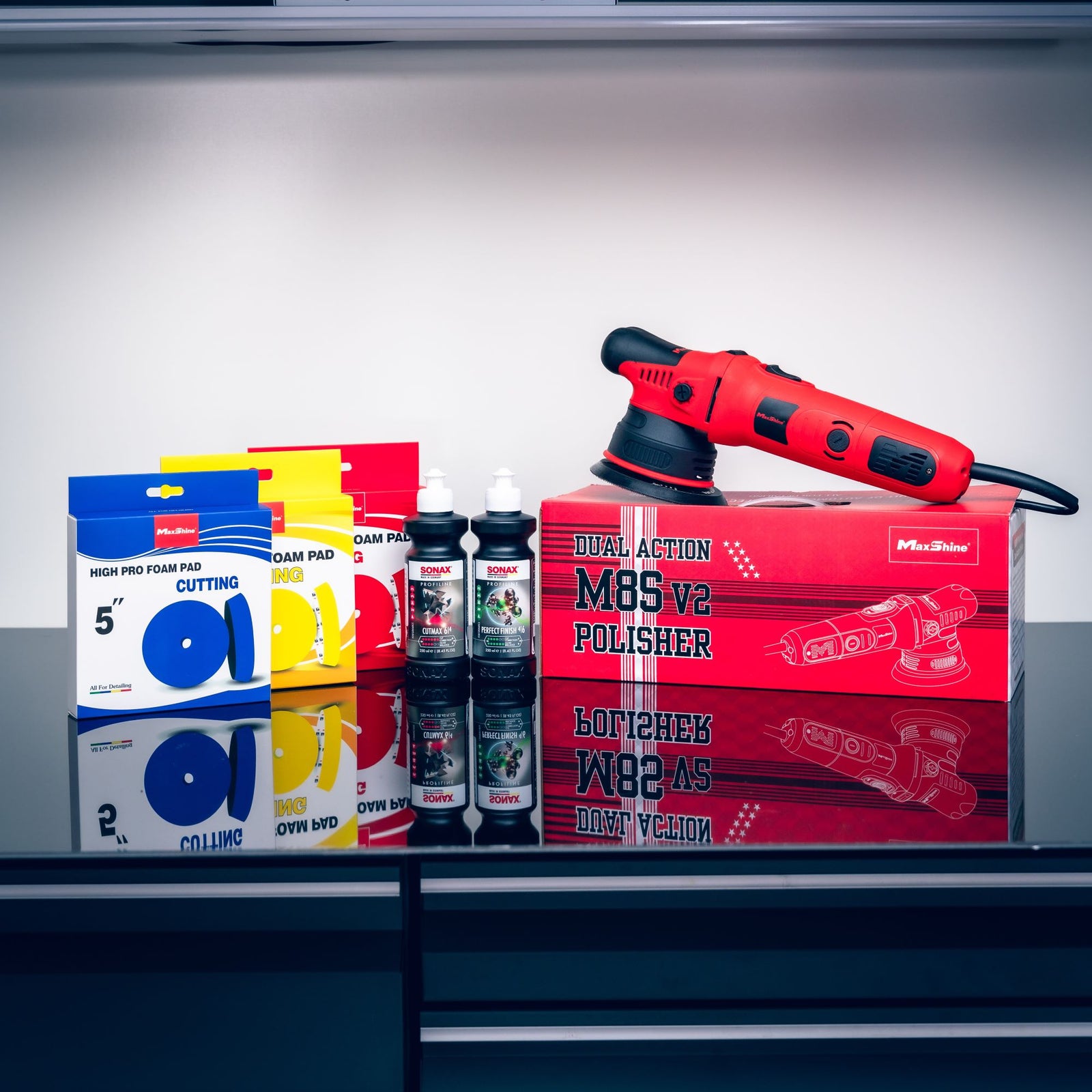






On Maxshine High Pro German foam, the colour is the grade. Green is heavy cutting, blue is general cutting, yellow is polishing, red is finishing. Microfibre cuts faster than foam for the same effort, and wool is for the paint that foam will not shift. Learn those and the range makes sense.
Maxshine is far more than polishers, and the pad range reflects that. The High Pro German foam line is the everyday choice, backed up by microfibre for faster cutting and wool for paint that has been properly neglected. Here is the whole range written down, plus which one to reach for on each job.
The Maxshine Pad Families
Which Maxshine Pad Should I Buy?
| If you want to... | Reach for |
|---|---|
| Remove heavy defects fast | Microfibre cutting, or premium wool |
| Cut with foam | Green heavy cutting |
| Do a general correction pass | Blue cutting |
| Refine after compounding | Yellow polishing |
| Maximise gloss before coating | Red finishing |
High Pro Foam, By Colour
Most aggressive at the top, softest at the bottom. Green and Blue are both cutting pads, but Green is the heavier of the two, so do not assume they are interchangeable.
| Colour | Grade | Use it for |
|---|---|---|
| Green | Heavy cutting | The most aggressive foam in the range. Deeper defects and oxidation. |
| Blue | General cutting | A balanced, moderate density foam. The versatile all rounder for typical correction work. |
| Yellow | Polishing | Light defects and refining after a cut. |
| Red | Final finishing | Final gloss and laying down wax or sealant. |
Green and Blue both cut, and that is where people mix them up. Green is the one for genuine heavy defects and oxidation, Blue is the everyday cutting pad for a typical correction. If you only own one cutting pad, make it Blue, it covers more jobs without being overkill.
Maxshine also make a Cross Cut foam pad with a horizontal and vertical cut face, designed to reduce heat and deliver compound more efficiently. It is a separate line from High Pro, worth knowing about if you see it listed under a different name.
Microfibre Pads
Microfibre cuts faster than foam for the same effort, which makes it the quick way through hard clear coats and heavier defects on a dual action.
| Pad | Grade |
|---|---|
| Microfibre Cutting Pad | Heavy cutting |
| Microfibre Polishing Pad, One Step | One step correction and finish |
| Microfibre Finishing Pad | Finishing |
Wool Pads
When foam is not getting there, wool will. It cuts harder, so on badly damaged or oxidised paint it saves you a stack of passes. Always follow it with a foam refine.
| Pad | Grade |
|---|---|
| Wool Cutting Pad | Heavy cutting |
| Premium Wool Cutting Pad, 100% wool | Heavy cutting |
| Wool Cutting Pad, Torsional Rubber Backed | Heavy cutting |
The torsional rubber backed version adds a flexible backing that helps the pad follow curved panels while it cuts. The Premium is 100% natural wool for good bonding and buffing effect. The standard Wool Cutting Pad is the entry point if you just need something that cuts hard without the premium price.
Glass, Interface Pads and Kits
| Pad | Use it for |
|---|---|
| Rayon Glass Wool Polishing Pad | Glass polishing, removing water spots and light scratches from glass |
| Soft Foam Interface Pad | Sits between the backing plate and your main pad, helps it follow curved panels |
| High Pro Polishing Pad Kit | A full set covering heavy cutting through to finishing in one box |
Match Your Compound to a Pad
Work out the cut level of the compound you are running, then read across. This holds for any brand of compound, since grade is grade. Switching from another pad brand, or want the full equivalents list? Our Maxshine Pad Cross Reference Chart lines them all up.
| Grade | Foam | Microfibre or wool |
|---|---|---|
| Heavy cut | Green | Microfibre cutting, or Premium wool |
| General cut | Blue | Microfibre cutting |
| All in one | Blue | Microfibre one step |
| Polishing | Yellow | Microfibre one step |
| Finishing | Red | Microfibre finishing |
Paint hardness moves everything. On a soft clear you can often drop a grade, on a hard clear you go up one. Do a test section first, read the result, then commit to the panel.
Sizing and Backing Plates
Maxshine pads run in 3, 5 and 6 inch sizes across most of the range, and attach with standard hook and loop, so they fit any dual action or rotary with a matching backing plate. Match the pad to your plate, not to the panel.
Not sure which plate your machine takes, or which polisher to buy in the first place? Our Complete Guide to Maxshine compares every polisher in the range side by side.
Pad Care
Clean as you go. Brush or blow the spent compound out every couple of sections. A loaded pad stops cutting and starts smearing.
Wash after every job. Maxshine foam and wool pads are washable and reusable. Air dry face up, never in the dryer.
Own more than you think you need. Two or three of each grade minimum. Swapping to a fresh pad partway through is the difference between a finish you are happy with and one you talk yourself into.
Questions I Get Asked
Green is heavy cutting, blue is general cutting, yellow is polishing and red is finishing. Green and blue both cut, green is the more aggressive of the two.
Green is a heavy cutting pad for genuine defects and oxidation. Blue is a moderate density, general purpose cutting pad for typical correction work. If you only buy one cutting pad, blue covers more jobs.
Foam is forgiving and finishes easily. Microfibre cuts faster for the same effort, useful on hard clear coats. Wool cuts hardest of all, for genuinely damaged or oxidised paint. Plenty of people cut with microfibre or wool and refine with foam.
It sits between your backing plate and your main pad, adding a layer of soft foam that helps the whole stack follow curved panels more evenly and reduces the risk of hard edge marks.
Yes, they use standard hook and loop backing, so they fit any dual action or rotary with a matching size backing plate.
Tell us what polisher and compound you are running and we will tell you exactly which pads to grab.
Shop Maxshine Pad cross reference chartRelated: Complete Guide to Maxshine polishers, all buffing pads and polishing compounds.