FREE Shipping on orders over $150 (Weight Restrictions Apply)


Detailing Shed | Maxshine Australia
Every Maxshine polisher, pad, brush and towel we stock. What each one is for, what it is not for, and which one to buy first. Written by the Australian master distributor, eight years in.
Jump to: What Is Maxshine · Why Choose Maxshine · Which Tool For Which Job · Polishers · Which Polisher Should You Buy · Polishing Pads · Wheels & Tyres · Washing & Buckets · Decontamination · Microfibre & Towels · Interior · Setup & Storage · Beginner Buying Guide · Common Mistakes · FAQ
Maxshine make detailing tools rather than chemicals. Polishers, pads, brushes, microfibre and the gear that holds it all together. Over the years they have gone from a pad manufacturer to one of the most complete tool ranges available, and they have done it by keeping the price sensible while the quality kept climbing. That combination is why you now see Maxshine machines in professional shops next to gear costing twice as much.
The polishers are the headline act. Japanese bearings, steel counterweights and Australian plugs, in a range that runs from an entry level dual action right through to brushless and cordless machines. Around that sits everything else you need to actually use them: German foam pads in every grade, brushes for jobs you did not know had a dedicated brush, and microfibre in enough weights and weaves to cover the whole car.
Match the job to the tool.
| The Job | The Tool |
|---|---|
| First time machine polishing | M8S V2 Dual Action |
| Correcting a whole car faster | M15 PRO v2 Dual Action |
| Utes, vans, boats and big panels | M21 PRO 21mm |
| Daily use with no motor servicing | MB15 PRO Brushless |
| Heavy defects and wet sand refinement | M1000 Rotary |
| Pillars, mirrors and tight spots | Mini Cordless M0312 V2 |
| Cutting heavy defects | High Pro Blue Cutting Pad |
| Refining to gloss | High Pro Red Finishing Pad |
| Finding the swirls you missed | Paint Inspection Light |
| Cleaning wheel barrels | Wheel Cleaning Brush |
| Scrubbing tyres | Soft Grip Tyre Brush |
| Safe contact washing | Ultra Plush Wash Mitt |
| Drying without marring | Purple Duo Twisted Loop Towel |
| Removing bonded contamination | Magic Clay Towel |
| Applying a ceramic coating | Suede Coating Cloth |
| Cleaning carpets and mats | Drill Carpet Brush |
| Yellowed headlights | Headlight Restoration Kit |
The machines Maxshine built their name on. There are four families: brushed dual action, brushless dual action, rotary, and mini. Most people only need to understand the first two.
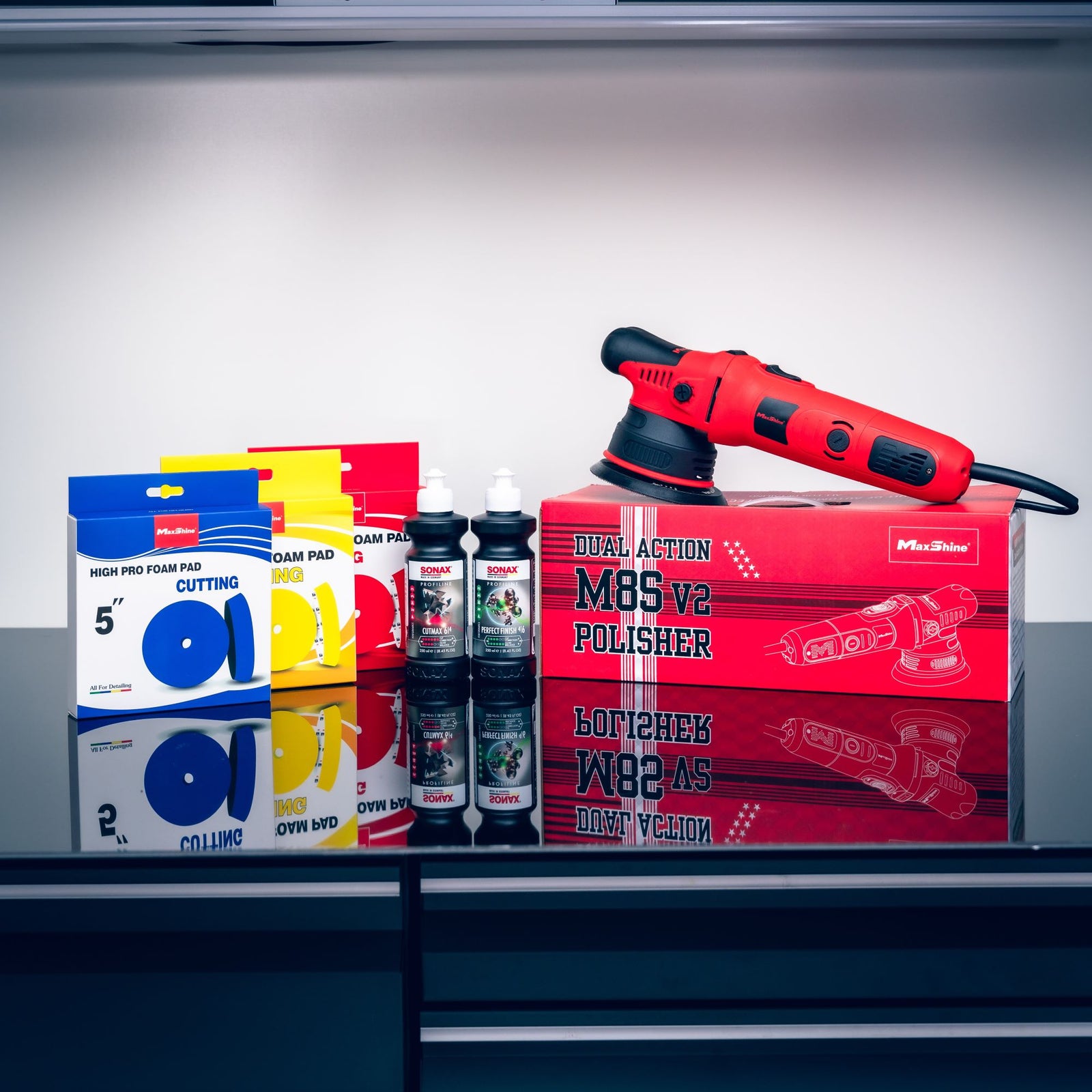
Use it for: your first machine polish. The short throw stalls easily under pressure instead of digging in, which sounds like a weakness and is actually the best safety feature a beginner can have. Also the one to grab around badges, mirrors and tight curves.
Not for: correcting a whole ute in an afternoon. Short throw covers less panel per pass, so it is slower over big flat areas.
Use it for: the sweet spot for most people. Long enough throw to correct a car properly, small enough plate to still be manageable on doors and bumpers. Japanese bearings, steel counterweight, four metre cable. If you are buying one machine to do everything, this is it.
Not for: a total beginner who has never held a polisher. Learn on the M8S first if you are nervous.
Use it for: big vehicles. Utes, vans, 4WDs, boats, anything with large flat panels. The 21mm throw and 6 inch plate cover ground fast, and it ships with a D handle, spare carbon brush set, gearbox grease and a storage pouch.
Not for: small cars with tight bodywork. A 6 inch plate on a hatchback is more machine than the panels can take, and you will fight it around mirrors and handles.
Use it for: the same job as the M15 PRO but with no carbon brushes to ever replace. More power, quieter, less vibration, soft start and a constant speed system that holds pad speed when you lean on it. Six metre swivel cord so it does not tangle as you work round the car. This is the one for anyone using a machine most days.
Not for: occasional weekend use where the extra cost is hard to justify. The brushed M15 does the same correction, you just service it occasionally.
Use it for: the big machine with no maintenance. Everything the M21 PRO does on large panels, with the brushless motor advantages of the MB15. The pick for a professional shop running large vehicles daily.
Not for: small cars, and not the first polisher you buy. This is a machine for someone who already knows exactly why they want 21mm.
Use it for: serious defect removal, wet sanding refinement and heavy oxidation, including marine work. Adjustable 800 to 3,300 rpm so you can cut hard then finish gently, sealed bearings, and auto shut off carbon brushes that protect the motor if it overheats.
Not for: beginners. A rotary spins the pad directly with no stalling safety, so heat builds fast and clear coat burns in seconds if you hold it in one spot. Learn on a dual action first, no exceptions.
Use it for: the MB1200 is the brushless rotary for shops doing heavy correction daily with no motor servicing. The M550 is a compact 3 inch rotary for spot repairs, headlights, pillars and small panels where a full size rotary will not fit.
Not for: general paint correction if you are still learning. Same rotary warning applies to both, size does not make a rotary safer.
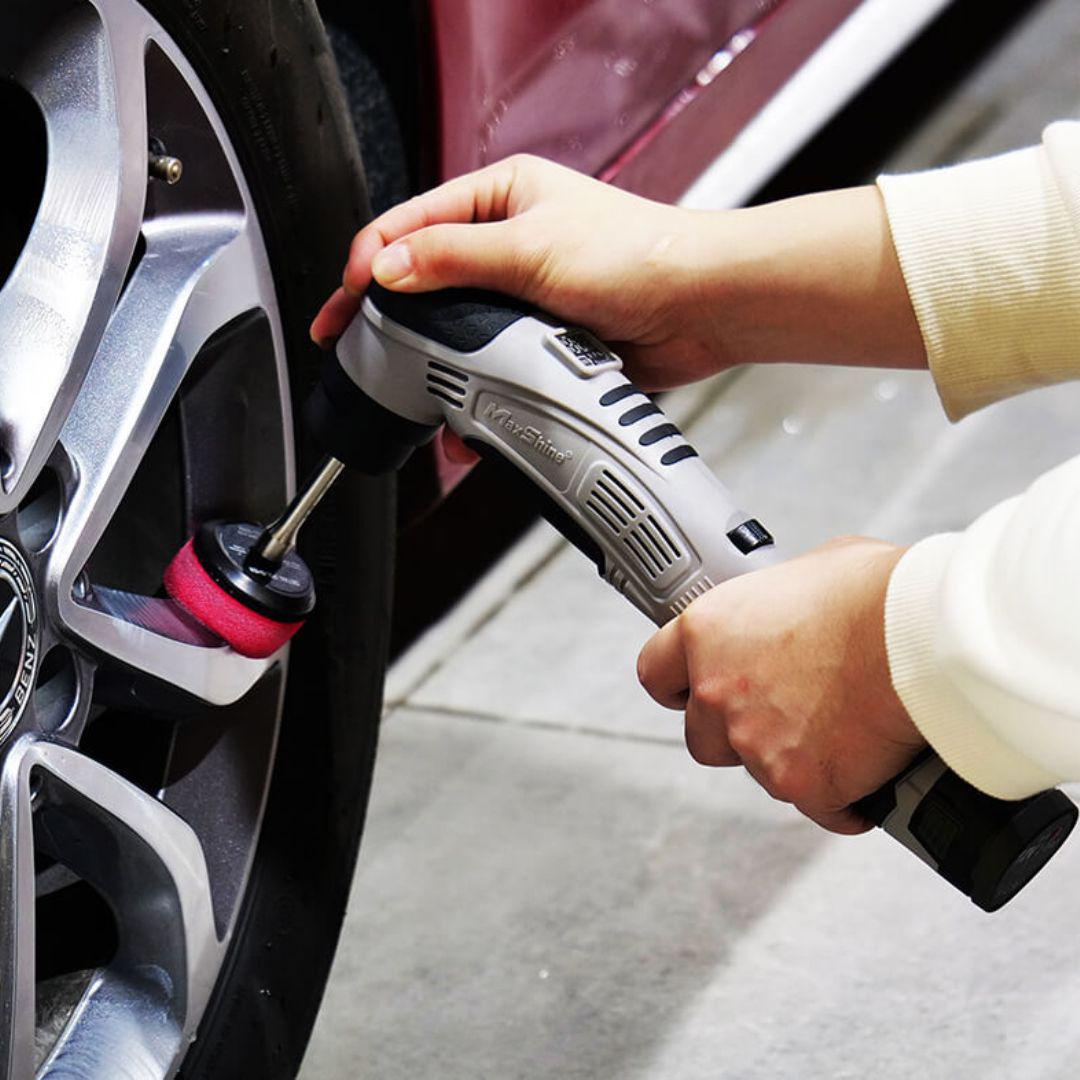
Use it for: everything the big machines cannot reach. A pillars, wing mirrors, bumper corners, door handles, bike tanks. Switches between dual action and rotary, comes with 1.5 and 2 inch plates, rotary extension bars, two batteries and an LED display for speed and battery life. No cord dragging across paint you just corrected.
Not for: doing a whole car. It is a spot and detail tool, not a replacement for a full size machine, and battery life will remind you of that.
Use it for: the really small stuff. Headlamps, fog lights, emblems, door handle cups, console panels, scratched glass. A full kit of tiny pads, backing pads and an M14 adaptor.
Not for: using on its own. The rotary polisher is not included, this kit runs off the M550.
The whole range side by side. Find your row.
| Machine | Type | Throw / Size | Motor | Best for | Skill level |
|---|---|---|---|---|---|
| M8S V2 | Dual action | 8mm, 5 inch | 1000W brushed | Learning, tight areas | Beginner |
| M15 PRO v2 | Dual action | 15mm, 5 inch | 1000W brushed | All round correction | Beginner to pro |
| M15 PRO G | Dual action | 15mm, 5 inch | 1000W brushed | Same as M15, green | Beginner to pro |
| M21 PRO | Dual action | 21mm, 6 inch | 1000W brushed | Utes, vans, boats | Intermediate |
| MB15 PRO | Dual action | 15mm | 1200W brushless | Daily use, no servicing | Intermediate to pro |
| MB21 PRO | Dual action | 21mm | Brushless | Large vehicles daily | Pro |
| M1000 | Rotary | 5 inch, 125mm | 1000W brushed | Heavy defects, marine | Experienced only |
| MB1200 PRO | Rotary | Full size | Brushless | Heavy correction daily | Experienced only |
| M550 | Rotary | 3 inch | Brushed | Spot repairs, headlights | Experienced only |
| M0312 V2 | Hybrid DA and rotary | 1.5 and 2 inch | 80W cordless | Tight spots, no cord | Beginner to pro |
| Mini System | Accessory kit | Tiny pads | Runs off M550 | Headlights, emblems | Intermediate |
The pad does more of the work than most people realise. Same compound on three different pads gives three different results.
| Pad | Grade | What it does |
|---|---|---|
| High Pro Blue | Cutting | Removes heavier swirls and defects |
| High Pro Yellow | Polishing | The middle ground, light defects and refining |
| High Pro Red | Finishing | Final gloss, applying glazes and sealants |
| Microfibre Cutting | Heavy cut | More bite than foam, for hard clear coats |
| Rayon Glass Wool | Glass | Glass polishing only, wiper haze and water spots |
Use it for: sitting between your backing plate and pad on curved panels. It lets the pad follow the shape of the body instead of fighting it, which means more even contact and less chance of hitting an edge too hard.
Not for: heavy cutting on flat panels. It softens the pressure you are putting down, which is the opposite of what you want when you are trying to cut.
Where every wash should start.
Use it for: the barrel of the wheel, the bit nobody can reach and everybody forgets. Soft bristles so it will not scratch a finish, long enough to get right through to the back.
Not for: scrubbing tyres. The soft bristles will not shift tyre browning and you will wear the brush out doing it. Use a tyre brush for rubber.
Use it for: agitating cleaner into the sidewall and lifting old dressing and browning out of the rubber. The low profile version is the one for modern cars where there is barely any sidewall to get at.
Not for: painted or polished wheel faces. Stiff bristles belong on rubber, not on a finish you care about.
Use it for: wheel faces, between spokes and around lug nuts where a brush is too clumsy. The finger design means you can actually feel what you are cleaning.
Not for: paint, ever. Once a mitt has been on a wheel it stays on wheels. Keep them separate and colour code them.
Use it for: laying dressing on evenly without getting it on the paint or your hands. The curved ones follow the sidewall properly. The covered version stops it drying out between uses, which is the one that annoys everybody.
Not for: applying product to paint or trim. Once an applicator has had tyre dressing in it, that is its job for life.
Use it for: wheels off the car. Coating, polishing or a proper deep clean. It spins so you can work all the way round without lifting, and it keeps the wheel off the ground and out of the dust.
Not for: a quick weekly wash. This is a tool for when the wheels come off and you are doing the job properly.
The stage where most damage happens, so worth getting right.
Use it for: the contact wash. Deep pile lifts grit up away from the paint instead of dragging it along the surface, which is the whole point of a good mitt. The cuff version keeps water out of your sleeve.
Not for: wheels, sills or anywhere really filthy. Keep a separate mitt for the dirty bottom third of the car and never let the paint mitt near it.
Use it for: the two bucket method, and the colours are the point. One colour for wash, another for rinse, another for wheels. When the buckets look different you stop putting the mitt in the wrong one.
Not for: running a single bucket setup and hoping. One bucket means you are rinsing grit off the mitt and then picking it straight back up again.
Use it for: the bottom of every bucket. Grit falls through and stays trapped underneath instead of swirling back up into your mitt. Cheapest scratch prevention you can buy.
Not for: skipping. People leave these out and then wonder where the swirls came from.
Use it for: keeping bottles and brushes on the bucket rim instead of on the ground, and rolling the whole lot around the car instead of carrying it. Sounds minor, saves a surprising amount of walking.
Not for: heavy lifting. The dolly is for rolling a full bucket on a flat floor, not for dragging up steps.
For the contamination a wash will not touch.
Use it for: pulling bonded contamination out of the paint until it feels like glass. Three separate bars means when you drop one you bin it and keep going instead of ruining the job.
Not for: using dry, or using again after it hits the ground. No lubricant means scratches, and a dropped bar picks up grit you will never fully get out.
Use it for: the same job as a clay bar but much faster over big panels, and it rinses clean instead of needing to be kneaded. If you decontaminate regularly this is the easier option.
Not for: heavy contamination on neglected paint. Traditional clay still has the edge when the paint is really bad. Always keep it well lubricated.
Use it for: yellowed, hazy headlights. Graduated sanding discs from P1000 through P3000, a drill backing pad, compound and a towel. Cuts the oxidation back and seals it so it stays clear.
Not for: lenses that are cracked or damaged internally. Sanding fixes surface oxidation, it will not fix moisture inside the housing or physical damage.
Different weights for different jobs. Using the wrong one is how good work gets undone at the last step.
| Towel | Use it for |
|---|---|
| Purple Duo Twisted Loop 1200GSM | Drying the whole car, huge absorbency |
| Vortex Drying Towel | Drying, alternative weave |
| Edgeless Ultra Plush 500GSM | Buffing waxes and sealants |
| 380GSM Edgeless 5 Pack | Polish and compound removal |
| 330GSM Edgeless 5 Pack | General all purpose work |
| 300GSM Glass Towel 5 Pack | Glass only, low pile for no streaks |
| Suede Coating Cloth 10 Pack | Applying ceramic coatings |
Brushes and tools for the inside.
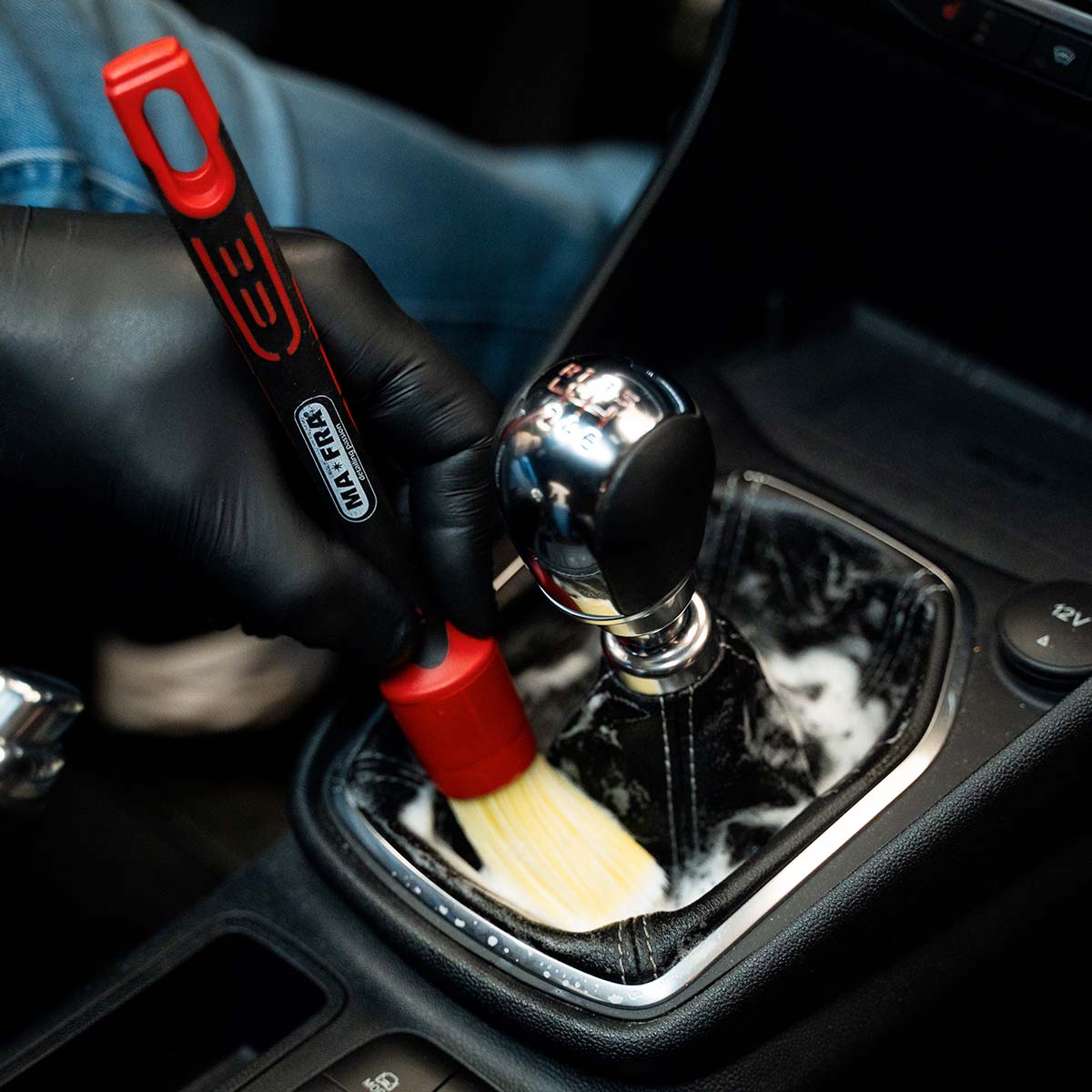
Use it for: vents, seams, badges, around switches and every gap dust collects in. Three sizes because the gap is never the size of the brush you are holding.
Not for: scrubbing hard on screens or piano black trim. Soft microfibre only on gloss surfaces.
Use it for: working cleaner into the grain of leather without damaging the finish, and lifting the fibres on alcantara so it does not go flat and shiny.
Not for: aggressive scrubbing on aged or cracked leather. Light pressure, let the product do the work.
Use it for: carpets, mats and fabric seats. On a drill it does in two minutes what takes twenty by hand, and it lifts dirt from deep in the pile rather than skating over the top.
Not for: leather, alcantara or delicate fabrics. And go easy on the trigger, a drill will chew through worn carpet backing.
Use it for: agitating cleaner into textured plastics, and the swabs for the tiny gaps around buttons, vents and badges that nothing else fits into.
Not for: screens, gloss trim or anywhere a scuff would show.
The gear that makes the rest of it easier to use.
Use it for: seeing what you are actually doing. Swirls and holograms hide under normal shed lighting and appear the moment the car rolls into sunlight. This finds them before your customer does.
Not for: skipping if you are polishing. Correcting paint without proper inspection lighting is guessing.
Use it for: diluting concentrates accurately and storing them in something that will not perish. Colour options so you can tell your wheel cleaner from your interior cleaner at a glance.
Not for: guessing dilutions. If you are buying concentrates to save money, measuring properly is how you actually save it.
Use it for: getting everything off the bench and onto the wall where you can see it. Brushes dry properly hanging up instead of sitting damp in a bucket.
Not for: plasterboard without proper fixings if you are loading it up with full bottles.
Use it for: masking trim, rubber and badges before you polish. Automotive grade so it comes off clean instead of leaving adhesive behind and giving you a second job.
Not for: leaving on in the sun for days. Even good tape gets harder to remove the longer it bakes.
Starting from nothing? This order makes sense.
Fix the wash first. More paint damage happens here than anywhere else, and no machine will save you from bad wash technique.
Drying is the second most common cause of swirls. A big twisted loop towel lets you pat and drag less.
Wheels get filthiest fastest and need their own dedicated tools that never touch paint.
Once the wash is sorted, decontamination is the next real step up in how the paint feels and looks.
Now you are ready for machine work. Buy the machine, three pads and an inspection light together.
A polisher on a car that is washed badly just corrects swirls you will put straight back next weekend. Sort the wash first.
One pad per car is not enough. A loaded pad stops cutting. Have several of each grade and swap as you go.
Glass, drying, polish removal and coating cloths all do different jobs. Colour code them and keep them apart.
Once a mitt or brush has touched a wheel it never goes near paint again. Brake dust embeds in the fibres.
Shed lighting hides swirls. You will think you are finished and the sun will tell you otherwise.
Clay without lubricant marrs paint immediately. Keep the surface wet and keep the clay clean.
Yes. They are a genuine professional tool brand rather than a budget alternative, and their polishers and German foam pads are used in working shops worldwide. The value comes from sensible pricing, not from cutting corners on the parts that matter.
The M8S V2. The short throw makes it forgiving, it stalls rather than digging in, and it is easy to control around tight bodywork while you learn.
Throw length and power. The M8S has a short throw which is safer and better in tight areas but slower over big panels. The M15 PRO has a longer throw and more power, so it corrects a whole car considerably faster. Beginners start with the M8S, people doing this regularly move to the M15.
Carbon brushes are a wear part in a normal motor. They slowly grind down and eventually need replacing, which is cheap and simple but it is maintenance. A brushless motor has none, so there is nothing to wear out, plus you get more power, less noise and less vibration. If you polish most days, brushless pays for itself. If you polish a few times a year, a brushed machine like the M15 PRO does the identical correction for less money.
How far the pad travels on each rotation. An 8mm throw moves a short distance, so it is gentler, easier to control and better in tight areas. A 21mm throw covers far more panel per pass, so it corrects big flat areas much faster but is clumsy around mirrors and handles. 15mm sits in the middle and is why the M15 PRO suits most people.
Not as your first machine, and probably not at all unless you are doing heavy correction regularly. A rotary spins the pad directly with no stalling safety, so it cuts faster and burns clear coat just as fast. Learn on a dual action, put real hours in, then consider a rotary like the M1000 if you genuinely need the extra cut.
Size of what you are polishing. The M15 PRO with its 5 inch plate suits cars and is the better all rounder. The M21 PRO with 21mm throw and a 6 inch plate is built for utes, vans, 4WDs and boats where big flat panels reward the extra coverage. On a hatchback the M21 is more machine than the panels can use.
Yes. They use standard hook and loop backing, so they work on any dual action or rotary polisher with a matching backing plate size. Just match the pad size to your backing plate.
Blue cuts, yellow polishes, red finishes. Blue for heavier defects, yellow for light defects and refining, red for final gloss and applying sealants. See the pad table above.
More than you think. At least two or three of each grade for a full car. Pads load up with spent compound and a loaded pad stops cutting properly, so you want to swap to a fresh one partway through rather than push on with a clogged pad.
Faster, and easier to keep clean since it rinses rather than needing kneading. Traditional clay still has a slight edge on badly neglected paint. For regular decontamination the towel is the easier option, and both need plenty of lubricant.
The bits a full size machine cannot reach. A pillars, mirrors, bumper corners, door handles, bike tanks. It is a companion to a full size polisher, not a replacement for one.
If you are machine polishing, yes. Normal lighting hides swirls and holograms, and you find out you missed them when the car goes out into the sun. It is the cheapest way to improve your results.
No. Brake dust embeds into microfibre and stays there, so a wheel mitt on paint drags metal particles across your clear coat. Keep them permanently separate and colour code so they never get mixed up.
Match it to your backing plate, and go smaller for tight or curved panels and larger for flat panels like bonnets and roofs. Most people run 5 inch as their main size with 3 inch for the awkward areas.
Yes. Detailing Shed is the Australian master distributor for Maxshine and we have been selling the range for eight years. We bring the range in and supply stockists around the country as well as selling direct, so you can buy from us or from your local Maxshine retailer. Either way warranty is handled here in Australia rather than chased through an overseas seller.
Ring us and we deal with it. As the master distributor we handle warranty here in Australia rather than passing you overseas, and that applies whether you bought from us or from one of our stockists. We hold spare parts, so things like backing plates and carbon brushes can usually be sorted straight away instead of waiting on an international order.
Yes, we stock them. Backing plates, carbon brushes and machine parts are the ones that wear and they are the ones we keep on the shelf. A polisher you can service is a polisher that lasts, which is a large part of why we back the brand.
Wash separately from normal laundry, no fabric softener ever, and keep the different types apart so glass towels do not pick up wax residue from polish towels. Softener clogs the fibres and kills absorbency permanently.
Detailing Shed is the Australian master distributor for Maxshine and has stocked the range for eight years. Recommendations on this page are based on manufacturer guidance and eight years of practical use in our own workshop and in the hands of the detailers we supply. Always follow the instructions supplied with your machine and test any new pad, tool or technique on an inconspicuous area first. The Maxshine range is larger than the products featured here, browse the full collection for everything we stock.
Not sure which one you need?
Tell us what you drive, what you already own and what you are trying to fix, and we will put together a shortlist from the gear we use ourselves. No upselling, just the right tool for the job. As the Australian master distributor we can answer anything about the range, including parts and warranty. If you are a retailer or detailer looking to stock Maxshine, get in touch about that too.
Shop The Full Maxshine Range Get In Touch