










Home › Buying Guides › Foam Cannon Wash Method
Detailing Shed · How To
The Foam Cannon Wash Method: How I Actually Wash a Car
Most of the swirl marks I see on customer cars didn't come from bad products. They came from washing in the wrong order. This is the foam cannon wash process I use at the Shed and at home, and it's the safe car washing method I've talked thousands of customers through over the years.
Nothing in this guide is complicated. There's no secret product and no special technique that takes years to learn. If you want to know how to wash a car without scratching it, it comes down to an order of operations, and once it clicks, you'll never wash a car any other way. Grab a coffee, read it once, and you'll have it. No pressure washer? The bucket wash method follows the same principles with just a hose.
In this guide
- Why foam washing works
- What you'll need
- Why I'll never use a sponge
- Prep the area
- The three buckets
- Wheels first. Always.
- Snow foam and rinse
- The contact wash
- Final rinse, dry and finish
- The process at a glance
- How we wash our own vehicles
- Washing in Australian conditions
- Common foam wash mistakes
- Troubleshooting watery foam
- Foam wash vs bucket wash
- Foam wash vs rinseless wash
- Products we use
- Frequently asked questions
- Keep learning
Why Foam Washing Works
Let's clear up the biggest misconception first. Snow foam is not designed to completely clean your car, and no honest detailer will tell you it is.
The job of a snow foam wash is to loosen as much dirt, road grime and contamination as possible before your wash mitt ever touches the paint. The foam clings, dwells, and breaks the dirt's grip on the panel, and the rinse then carries it off the car. That's it. And it's exactly why it matters so much.
Every scratch and swirl mark starts the same way: a particle of grit gets dragged across the paint under pressure. The less contamination on the panel when contact happens, the lower the risk. That's the entire logic of the foam wash method, and it's why a foam pre-wash is one of the safest ways to maintain modern paintwork. Today's clear coats look spectacular but they mark easily, and once swirls are in, the only way out is machine polishing.
Done properly, a foam pre-wash makes the whole job:
- Safer for your paint
- More effective
- Far less likely to put defects into the finish
- And honestly, a lot more enjoyable
What You'll Need
- Snow foam / pre-wash shampoo. I use Labocosmetica PRIMUS 2.0
- Car shampoo. ARMOUR Detail Supply Shampoo+ is my go-to
- Dedicated wheel cleaner. I use Optimum Power Wheel and Tire Cleaner
- Pressure washer and foam cannon
- 3 x wash buckets (wash, rinse, and wheels)
- DETAIL GUARDZ Dirt Lock inserts (one per bucket)
- DETAIL GUARDZ Hose Guides
- Dedicated microfibre wash mitt
- Wheel brushes (barrel brush, face brush, tyre brush)
- Microfibre drying towel or car blower (ideally both)
Why I'll Never Use a Sponge
After years of talking to customers, this still surprises me: people washing $60k, $80k, $100k cars with a foam sponge from the supermarket.
Here's the problem. A foam sponge has no pile. Whatever grit it picks up sits right at the contact face, and you drag it across the panel like sandpaper. That's where most swirl marks come from.
A proper microfibre wash mitt works differently. The long fibres lift dirt up and away from the surface and hold it there until you rinse the mitt out. Swapping a sponge for a mitt is the cheapest paint protection you'll ever buy.
1Prep the Area
Park in the shade. Australian sun will dry soap and water onto your paint faster than you can rinse it off, and that's how you end up with water spots on a car you just washed.
Get everything out and ready before the car gets wet. Once you start, you want to keep moving.
One small thing that makes a big difference: slip a Hose Guide under each wheel. Anyone who's had a pressure washer hose snag on a tyre mid-wash knows exactly why these exist. The hose glides around the corners of the car instead of catching and yanking.
2The Three Buckets
| Bucket | What goes in |
|---|---|
| Wash | ARMOUR Shampoo+ and water, mixed to the ratio on the bottle. Don't guess the dilution. More soap isn't more clean. |
| Rinse | Plain clean water. Your mitt gets rinsed in here after every panel. |
| Wheels | Shampoo and water. This bucket never touches paint. Ever. |
The Dirt Lock. Every bucket I own has a Dirt Lock in the bottom. Yes, we're the Australian distributor for Detail Guardz, so make of that what you will. But there's a reason I took on the brand. A flat grit guard just gives dirt somewhere to sit. The Dirt Lock's one-way design traps it underneath so it can't swirl back up into the water and onto your mitt. Rub your mitt against it and watch the dirt fall through.
3Wheels First. Always.
Wheels are the dirtiest thing on the car. Brake dust is metallic, it's abrasive, and if you wash your wheels last you'll flick it all over panels you've already cleaned. Do them first, and anything that splashes gets washed off in the stages that follow.
- Foam the wheels and tyres and let the product dwell. Check your cleaner's label, usually somewhere between 1 and 5 minutes. Don't let it dry on.
- Pressure wash it off.
- Spray wheel cleaner on the rims and tyre cleaner on the tyres, and let it work. This step breaks down the brake dust and road grime the foam didn't shift, so the mitt and brushes aren't doing it the hard way.
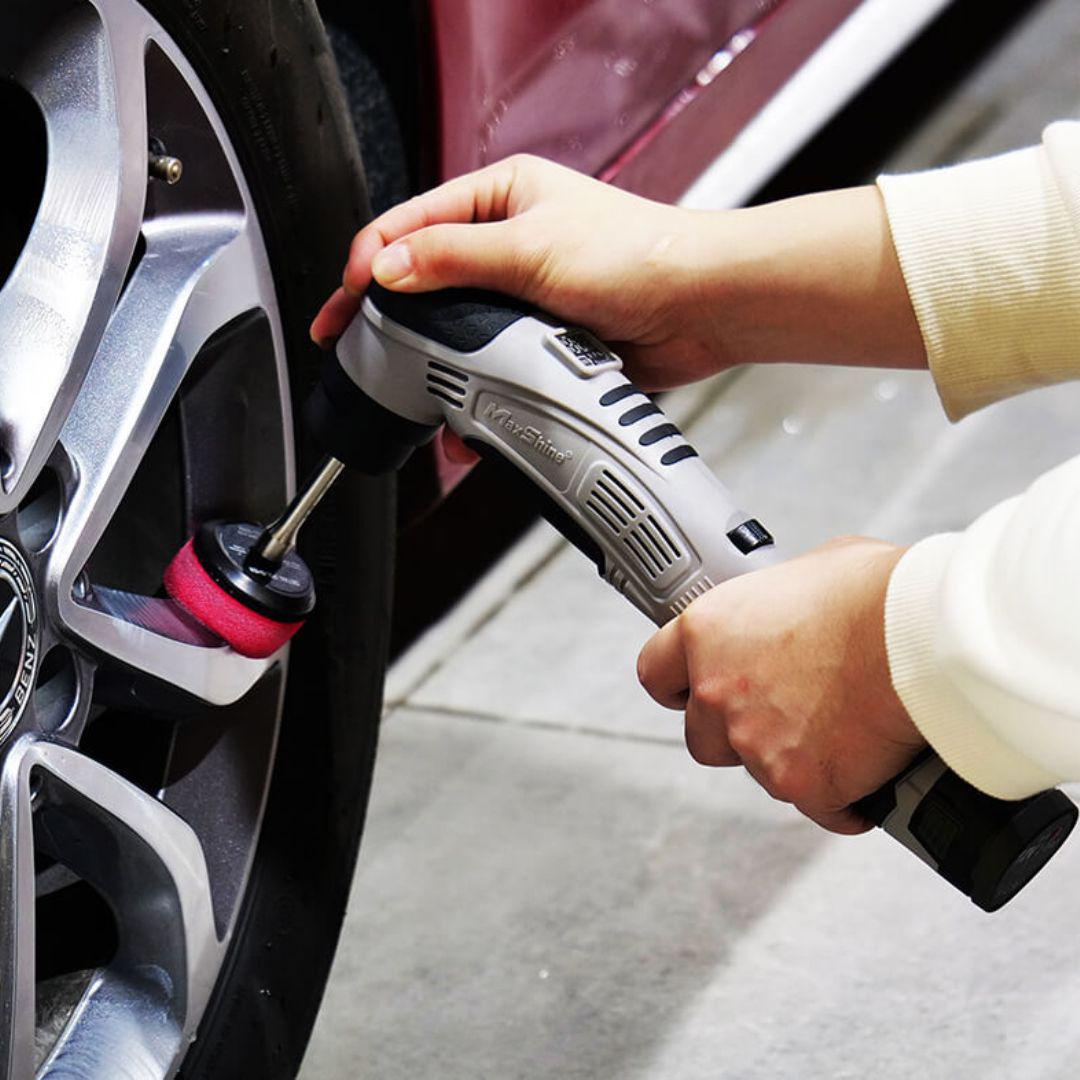
- From your wheel bucket, use a wheel mitt to work the face of the wheel first, or a soft wheel brush.
- Inner barrel last. It holds the most grime, and you don't want to drag that onto a face you've just cleaned. A long barrel brush gets through the spokes easily.
- Scrub the tyres with a stiff tyre brush. Old dressing and road film need to come off before new dressing goes on.
- Rinse the whole corner and move to the next wheel.
The order matters. With a foam cannon, we always foam the wheels first and finish the wheel job completely. Then we foam the car, rinse it, and move on to the bucket wash process. Wheels never come after paint.
4Snow Foam
We foam the car first, before any water touches the paint. Fill the foam cannon with snow foam at the dilution on the bottle. PRIMUS 2.0 runs at 1:10. Cover the whole car, roof down, and let it dwell.
Foam applied to a dry car clings longer and gets more time to loosen the dirt where it sits, and this stage is your best defence against swirl marks. The less dirt left on the car when your mitt arrives, the safer the wash.
Some detailers prefer a quick rinse before foaming. We foam the dry car because the product clings longer and gets more dwell time on the dirt. Either way, the foam stage is doing the same job.
5Rinse It All Off
Pressure wash the foam off, roof down. One goal: carry the loosened dirt off the car before the contact wash begins.
6Foam Again (Optional)
If I want extra lubrication for the contact wash, I'll refill the cannon with car shampoo (not the pre-wash foam) and foam the car a second time, then wash through it. On a lightly dirty car, you can skip this and go straight to the mitt.
7The Contact Wash
This is the part everyone pictures when they think "washing the car," and it's also where the damage happens if the earlier steps got skipped. Mitt in hand:
- Start on the roof and work down, panel by panel. The lower third of the car is the dirtiest, so it goes last.
- Straight lines, never circles. If there's any grit in the mitt, circles carve it into those round swirl patterns you see in direct sun.
- After each panel, dunk the mitt in the rinse bucket and rub it against the Dirt Lock. Then reload from the wash bucket.
- Keep moving. Nothing should dry on the paint. On a warm day, work smaller sections.
8Final Rinse
Rinse until every trace of suds is gone. Soap hides around badges, mirrors, trim, and inside door jambs, and whatever you miss will creep out and dry into streaks. Give those areas an extra pass.
9Dry the Car
Here's the part most people get wrong. The majority of wash-induced swirl marks happen during the washing and drying stages, not out on the road. By drying time the paint is at its cleanest and most exposed, with no soap film for lubrication. That's why proper drying towels, blow drying and a lubricating drying aid matter just as much as everything above. Get the wash right and then rush the dry, and you've undone the lot.
Never let the car air dry either. Evaporating water leaves its minerals behind, and that's exactly what a water spot is. In our sun it happens in minutes.
My preference is blower first, towel second. The blower pushes water out of mirrors, badges, and panel gaps. Those are the spots that drip onto your dry panels ten minutes after you've finished. Then a big microfibre drying towel handles what's left.
Let the towel do the work. Lay it flat, glide it lightly, and don't press. Scrubbing a car dry is one of the most common ways people put swirls into their own paint, right at the finish line.
Wheels get dried last, with their own towel. Once a towel has touched a wheel, it's a wheel towel for life.
Go deeper: I wrote a full guide on how to dry your car without scratching it. Two-towel method, drying aids, the lot.
10Tyre Shine (Optional)
Finish with an even coat of tyre dressing. It's the last five minutes of the job and it makes the whole car look done.
The Process at a Glance
- Clean wheels and tyres first
- Apply snow foam to the dry vehicle
- Allow dwell time
- Thorough rinse
- Contact wash with a quality mitt and two buckets
- Final rinse
- Blow dry where possible
- Finish with a drying aid
That's the exact foam cannon wash process we use and recommend here at the Detailing Shed. Print it, stick it on the garage wall, and it becomes second nature within a couple of washes.
How We Wash Our Own Vehicles
People ask this a lot, so here's the honest answer. There isn't one wash. There are two, and knowing which one to run is half the skill.
The full wash
When a car is properly dirty, or it's getting attention before protection or polishing work, it gets the complete process on this page. Wheels first, snow foam, contact wash, blow dry, drying aid. At the Shed we run this off a Kranzle wall mount pressure washer setup with water filtration, because spot-free rinses matter when you're chasing a perfect finish. At home I run the same method with the same gear.
The maintenance wash
My daily drivers get washed twice a week, because they cop the most road grime. The weekend cars get theirs weekly or fortnightly, depending on how much they've been driven. If a car picks up light dust or road film between washes and it's bothering me, I'll do a rinseless wash rather than drag out the full setup. Faster, less water, no hose required, and completely safe on light dirt. Our guide on why detailers use Optimum No Rinse explains how it works.
The takeaway: match the wash to the dirt. Heavy soiling gets foam. Light dust gets rinseless. Using the biggest process every time wastes water and time, and using the lightest process on a filthy car risks your paint.
Washing in Australian Conditions
Most car wash guides online are written for the UK or the US. Australian conditions are harsher in almost every way that matters, so here's how to adjust.
Summer washing
Panel temperature is your enemy. A dark bonnet in January sun can hit temperatures that flash-dry foam and rinse water in under a minute. Wash early morning or late afternoon, keep the car in shade, touch-test panels before you start, and work one section at a time, re-wetting as you go. If the panel is too hot to hold your hand on, it's too hot to wash.
Coastal vehicles
Salt air settles on everything and accelerates corrosion on trim, fasteners and unprotected paint. If you live near the water, wash more frequently, let the foam stage do its full job, and get some protection on the paint. A ceramic coating or a regularly topped-up spray coating makes salt film release with far less effort.
4WDs and off-road dirt
Mud and bulk dirt is exactly what the foam wash process was made for. Foam twice if you need to, letting each round dwell and rinsing fully in between, and expect to rinse your mitt more often than usual during the contact wash. Don't forget the underbody and wheel arches after beach or bush trips, salt and mud sitting in there does more long-term damage than anything on the paint. We stock a dedicated 4WD and off-road range for exactly this.
Hard water areas
If you're in Perth, Adelaide or anywhere with mineral-heavy water, your rinse water is leaving deposits every time it dries on the paint. Dry faster, use a blower, and consider a de-ionising water filter for a spot-free final rinse. It's the single biggest quality-of-life upgrade for hard water regions, and it's why we run filtration at the Shed.
Common Foam Wash Mistakes
Letting foam dry on the paint
Wash in the shade where possible and never let foam dry on the surface. Dried product is harder to rinse off and can leave streaks and spotting behind.
Using too much shampoo
More foam doesn't equal more cleaning power. Follow the recommended dilution ratio on the bottle. The right mix foams properly, cleans properly, and rinses clean.
Foaming hot panels
Foam flashes off almost instantly on a sun-heated panel, which means no dwell time and baked-on residue. Touch-test the panel before you start, and wash early or late on hot days.
Using dirty wash media
A clean mitt is critical. A dirty or poorly stored mitt puts grit straight back onto the paint, and no amount of foam fixes that. Our guide on how to wash microfibre towels covers keeping your mitts and towels safe for years.
Drying incorrectly
Many swirl marks happen during drying, not washing. Read our full guide on how to dry your car without scratching it before your next wash.
Troubleshooting: Why Is My Foam Watery?
The most common foam cannon complaint we hear. Thin, runny foam usually comes down to one of these:
- Foam cannon adjustment dial set incorrectly
- Not enough shampoo concentration in the bottle
- A blocked foam cannon filter
- A pressure washer with low flow
- A poor quality foam cannon
Get the mix right: use our Foam Cannon Calculator to nail your dilution, and if your cannon is the problem, our best foam cannon guide covers what to look for.
Foam Wash vs Bucket Wash
Both methods follow the same order and both are safe when done right. The difference is what happens before the mitt touches the car:
| Foam Wash | Bucket Wash |
|---|---|
| Foam pre-wash loosens and removes most dirt before contact | Hose pre-rinse does the heavy lifting |
| Lowest possible swirl risk | Safe when the order is followed properly |
| Needs a pressure washer and foam cannon | Needs nothing beyond buckets and a hose |
| Faster on heavily soiled vehicles | Cheaper to get started |
If you're not set up with a pressure washer yet, start with the bucket wash method today and upgrade when you're ready. Our pressure washer packages bundle the cannon, gun and hose so you're not piecing it together yourself, and if you're considering a permanent setup, my Kranzle wall mount guide covers exactly what I run at work and at home.
Foam Wash vs Rinseless Wash
Foam washing isn't the only safe way to wash a car, and it isn't always the right one. Here's how the two methods compare:
| Foam Wash | Rinseless Wash |
|---|---|
| Ideal for heavily soiled vehicles | Perfect for maintenance washes |
| Great for 4WDs and off-road dirt | Faster setup and pack-down |
| Requires a pressure washer | Uses a fraction of the water |
| Higher water usage | Ideal for apartments and water restrictions |
I use both, depending on how dirty the car is. For rinseless washing, start with our guide on why detailers use Optimum No Rinse, see the complete P&S product guide for where Absolute fits in, or browse the rinseless washing range.
Products We Use
You don't need these exact products to follow the method. The order matters more than any bottle. But people always ask what we actually run at the Shed, so here it is, with the reasoning.
Foam cannon
The MTM Hydro PF22.3. It's the cannon we include in every one of our pressure washer packages because the foam quality and build are consistently right. What matters in any cannon: a quality mixing chamber, an adjustable dial, and a wide-mouth bottle you can actually refill without a funnel. Browse our foam cannon range.
Shampoo
Labocosmetica PRIMUS 2.0 for the pre-wash foam, and ARMOUR Detail Supply Shampoo+ in the wash bucket. What matters: pH-neutral for coated cars, high lubrication for the contact wash, and clean rinsing with no residue.
Wash mitt
A deep-pile microfibre mitt, replaced the moment it's dropped on the ground or starts shedding. What matters: pile depth (that's where the dirt hides, away from your paint) and how well it holds wash solution. See the wash mitts range.
Drying towel
Twist loop microfibre, one large for the horizontal panels and one medium for the sides. What matters: twist loop construction absorbs more with less pressure, which is the whole game in safe drying. Our drying towels collection covers sizes and GSM, and the drying guide explains the two-towel method.
Dryer / blower
A dedicated car blower for mirrors, badges, grilles and panel gaps. Zero contact means zero marring risk, which is why it's the first drying tool we reach for, not the last. See dryers and blowers.
Drying aid
A SiO2 detail spray misted onto each wet panel before towelling. It adds lubrication so the towel glides instead of grabs, and on coated cars it tops up the hydrophobic layer every single wash. One of the highest-value habits in this whole guide. See spray coatings.
Frequently Asked Questions
Can I foam wash without a pressure washer?
Yes. Hose-fed foam sprayers and pump foamers exist, though a dedicated foam cannon on a pressure washer gives the thickest foam and best results. If you're working with just a hose, follow our bucket wash method instead. Same principles, same protection.
How often should I wash my car?
It depends on how the car is used. My daily drivers get washed twice a week, and the weekend cars weekly or fortnightly. For most people, weekly or fortnightly is a solid routine. The longer dirt sits on the paint, the harder it bonds and the more work it takes to remove safely. A regularly washed car is a quicker, safer wash every time.
Is snow foam safe on ceramic coatings?
Yes. A quality pH-neutral snow foam is completely safe on coated vehicles, and this exact process is how you keep a coating performing. If your coating has stopped beading like it used to, read our guide on why ceramic coatings stop beading before assuming something's wrong with it.
Should I wash wheels first?
Yes, always. It stops brake dust and wheel grime splashing onto panels you've already cleaned. It's the first rule of this whole method.
Do I really need three buckets?
The two paint buckets are non-negotiable. The rinse bucket is what stops dirt going back onto the car. The third is for wheels, and it exists so brake dust never gets near anything that touches paint. Once you've seen the colour of the water in a wheel bucket, you won't want to share it.
Can I use dishwashing liquid instead of car shampoo?
Please don't. Dish soap is a degreaser. It strips waxes and sealants, dries out trim, and has none of the lubrication a proper car shampoo provides for the mitt.
Can I wash my car in direct sunlight?
Avoid it if you can. Sun flash-dries soap and rinse water into spots and streaks before you can get to them. Shade, early morning, or late afternoon makes the whole job easier and safer.
How much snow foam should I use?
Whatever the bottle says. Dilution ratios vary product to product. PRIMUS 2.0, my pre-wash of choice, runs at 1:10 in the foam cannon. Stronger isn't better; the right ratio foams properly and rinses clean.
My car is brand new. Do I still need all this?
Yes, and arguably more so. New paint is exactly what you're trying to preserve, and dealer washes are where many cars pick up their first swirls. Start with this process from day one and the paint stays as close to delivery condition as possible. It's also the perfect time to think about ceramic coating while the paint is still flawless.
Is snow foam safe on PPF, vinyl wraps and matte paint?
A quality pH-neutral snow foam is safe on all three. The bigger risks for film and wraps are high pressure aimed at edges and aggressive chemicals, so keep the lance at a sensible distance and angle away from edges and seams. We carry dedicated products in our PPF and vinyl range and matte finish range.
What pressure washer do I need for foam washing?
More than the bare minimum, less than you'd think. Foam quality depends more on water flow than raw pressure, which is why quality machines with good flow rates outperform cheap high-pressure units. Our pressure washer comparison lays out the options, and the Kranzle guide explains why flow rate matters more than pressure.
What about bird droppings and bugs?
Don't wait for wash day. Bird droppings and bug remains are acidic and etch into clear coat within days, especially in summer heat. Keep a quick detailer in the car and remove them as soon as you spot them. For baked-on remains, a dedicated bug and tar remover softens them off safely instead of scrubbing.
My paint feels rough even after washing. What's going on?
That's bonded contamination: iron fallout, tar and overspray that washing alone can't remove. It calls for a decontamination stage with an iron remover and clay bar, usually needed once or twice a year. If the paint feels like fine sandpaper under a plastic sandwich bag over your fingers, it's time to decontaminate.
The Bottom Line
A quality snow foam wash is one of the safest and most effective ways to wash your vehicle, and this is the car wash guide we point every Australian customer to first. Combine a proper foam pre-wash, quality wash media, safe drying technique and the right products, and you'll dramatically reduce swirl marks while keeping your car looking its best between details.
None of it is hard. It's just the right order, done consistently. And once washing is sorted, everything else in detailing gets easier, because you're no longer creating the defects you'd otherwise spend weekends correcting.
Keep Learning
Washing is stage one. These guides pick up where this one ends:
- How to Dry Your Car Without Scratching It. Where most swirls actually happen.
- How to Wash Microfibre Towels. Your mitts and towels are only as safe as your last wash.
- The Bucket Wash Method. The same principles without a pressure washer.
- Why Detailers Use Optimum No Rinse. The maintenance wash we use between foam washes.
- Why Your Ceramic Coating Stopped Beading. Diagnosis before you blame the coating.
- Kranzle Wall Mount Package Guide. The exact pressure washer setup we run at the Shed.
That's my method
No shortcuts, no secret products. Just the right order.
Missing a piece of the setup? Everything in this guide is stocked here at the Shed and ready to ship.
SHOP WASH & DRYNot sure what makes sense for your car and your space? Get in touch and we'll steer you right.
Nick, Founder, Detailing Shed